Fuel-Efficient Weed Control at Corcelettes Estate Winery
At Corcelettes Estate Winery, under vine weed management had long been a labour-intensive and fuel-consuming task. The team faced a familiar challenge: maintaining healthy vines and clean rows while minimizing chemical use, soil compaction, and operational costs. Their existing set-up relied on a single-sided grape hoe, gas-powered trimmers, and, at times, herbicides—a combination that required over a dozen passes each season and significant tractor time at high revolutions per minute (RPMs). As Brett Meier described, “Our current soil and weed management programs are incredibly time and labour intensive and require multiple passes with tractor implements and gas-powered weed trimmers. This upgrade improved labour efficiency and greatly reduced tractor inputs for under-vine weeds. All while reducing soil compaction, reducing fuel consumption, controlling weeds, and improving soil health overall.”
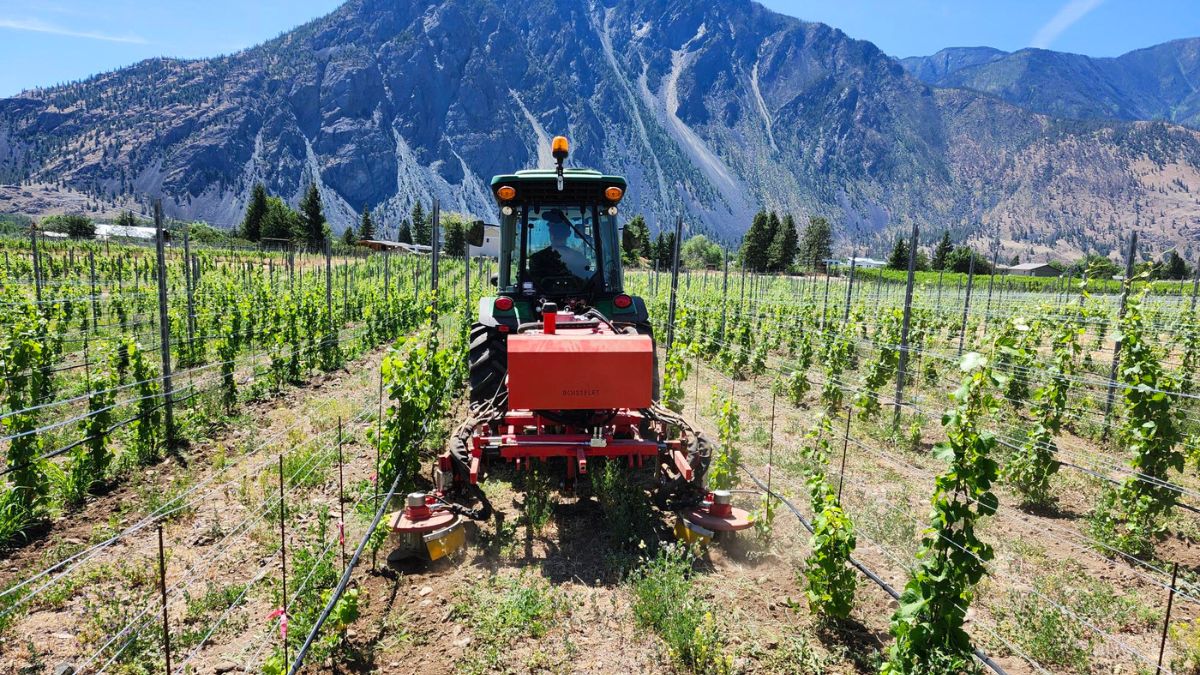
In 2025, the winery embarked on a Beneficial Management Practices (BMP) Energy & Fuel Efficiency project to replace/transition to fuel-efficient equipment, and to upgrade to a Boisselet tractor implement. Unlike their old equipment, the Boisselet system features a hydraulic booster pack that allows the tractor to operate at much lower RPMs while powering interchangeable weed control tools. This innovation enabled them to service two rows at once—reducing passes, labour hours, and fuel use.
“With the help of this BMP we have been able to upgrade our under vine weed control with this Boisselet tractor implement, and reduce our fuel consumption,” Brett shared. “The Boisselet has many interchangeable components; on the initial purchase we opted to try the Petalmatic blades to surface-till the under vine band, and the Rotofil Weed Trimmer for our rocky sites. This has reduced our fuel consumption considerably and has reduced our need for chemical herbicides. This has very positive long-term benefits to the soil and overall farm health. The labour we used to have to allocate to manual weed trimming has been greatly reduced and has given us an opportunity to keep up in other areas of the farming season. This was a benefit we overlooked – but has been greatly appreciated.”
This project demonstrates how BMP projects can lower measurable greenhouse gas (GHG) and create cost savings, while supporting soil and ecosystem health.
Funding for the BMP program has been provided by the Sustainable Canadian Agricultural Partnership, a $3.5 billion, 5-year agreement between the federal, provincial and territorial governments. Additional funding has been provided by CleanBC. The program is delivered by IAF.