Supporting farmers in BC and the Yukon tackle climate change through the adoption of beneficial management practices in three specific areas: nitrogen management, cover cropping and rotational grazing.

The Climate Agri-Solutions Fund helps farmers implement these practices through cost-shared funding. The program also supports outreach, education and training to give farmers the opportunity to learn how these practices can effectively store carbon and reduce greenhouse gases on their farms.

Subscribe

* indicates required
Area of Interest:

Program Objective

The objective of the Climate Agri-Solutions Fund (CAF) is to support BC and Yukon farmers with the adoption of beneficial management practices that store carbon and reduce greenhouse gases, specifically in the areas of nitrogen management, cover cropping and rotational grazing. These practices also provide other environmental benefits such as improved biodiversity and soil health.
Program Details

Approach

Funding is available to support farmers in:

  • New adoption of nitrogen management, cover cropping and rotational grazing practices
  • Expanding nitrogen management, cover cropping and rotational grazing practices on a farm area where these practices have not previously been used

The program also supports producers who have previously received funding through the program (or previous BC Climate Agri-Solutions Fund Program (BCCAF)) to continue the adoption of nitrogen management, cover cropping and rotational grazing practices.

Funding Amounts

Eligible farm businesses can apply for 85% cost-shared funding up to a maximum of $100,000 per farm.

Maximum Funding Amounts
Cost-Shared Ratio
$100,000 85% (unless otherwise noted)

What’s a Cost-Shared Ratio?

The cost-shared ratio is 85/15, meaning that 85% of the eligible costs for approved projects can be covered by CAF funding. The remaining 15% must be provided by the applicant.

What Does the Maximum Funding Amount Mean?

The maximum funding amount is the total amount of funding you can receive during the program term (2022-2028). The total funding amount you can receive for the program is $100,000.

Note: Funding received from the 2022/23 to 2024/25 BC Climate Agri-Solutions Fund (BCCAF) is included in the maximum funding amount.

Retroactive Costs

Eligible expenses that have already been incurred can be included in your application and will be considered retroactively (applies only to costs incurred from April 1, 2025, onwards).

Note: Any costs incurred prior to a funding decision by IAF are entirely at risk of the applicant (should funding not be awarded), and application to the program does not guarantee funding.

New! Book a Call

There are now more ways to get in touch with the IAF Team! Starting on the June 25, 2025 you can book a 10-minute phone consultation with an IAF staff member to discuss your CAF application.

Prior to booking a call, please start a draft application, as you must provide your application ID number (example: CAF-202526-0####) when you book the call. This gives you and the IAF staff member a specific application to reference and provide support for during the 10-minute phone call.

Applicants may be limited to one phone call appointment if demand is high. The IAF Team is also available at 250.940.6150 during business hours and by email at caf@iafbc.ca.

Eligibility Criteria

Eligible Projects & Applicants

Eligible projects:

  • A new practice being applied for the first time on a farm or a specific field/parcel
  • Expansion of a previously used practice to a new field/parcel where it has not previously been applied
  • Continuation of a practice that was previously applied as part of the CAF (or previous BCCAF) program

Eligible applicants:

  • Have a farm in BC or the Yukon
  • Be appropriately registered, licensed and/ or certified to conduct business in BC and/or the Yukon
  • Have farm status (BC applicants only)
  • Be registered with CRA
  • Be in operation for at least one year

Eligible Activities

The following activities are eligible for funding through CAF in their respective categories. All activities must contribute to the overall program goal of decreasing greenhouse gas emissions or increasing soil carbon.

Nitrogen Management

  • The price difference between regular fertilizer and inhibitor fertilizer
  • Nitrification and urease inhibitors must be used together
  • The price difference between regular fertilizer and polymer coated urea (PCU) fertilizer
  • Cost to split application of nitrogen fertilizer so that each application is at a reduced rate (e.g. custom rates for the costs for using the equipment and the associated fuel and contracted labour required for the additional fertilizer application)
  • Delaying a portion of nitrogen fertilizer should result in increased crop use efficiency and reduced nitrogen loss
  • Plan, assess, and design work, consultancy fees, and other agronomic support/technical training costs
  • These could include:
    • Nutrient management plans
    • Crop diversification plans to increase legumes and pulses in rotation
    • Engineering or technical work by a qualified professional
  • Plans, assessments or designs developed must be used with another nitrogen management practice activity that will directly result in carbon sequestration and/or reduced greenhouse gases, either in the current project or in a future project (e.g. adding legumes in rotation or soil amendments)
  • If the plans, assessments or designs developed permits producers to reduce the application of nitrogen on their farm, the reductions in nitrogen fertilizer will need to be reported
  • Soil testing and soil mapping must be used with another nitrogen management practice activity that will directly result in carbon sequestration and/or reduced greenhouse gases, either in the current project or in a future project (e.g. legumes in rotation or soil amendments)
  • If soil testing and soil mapping permits producers to reduce the application of nitrogen on their farm, the reductions in nitrogen fertilizer will need to be reported
  • Soil testing and soil mapping costs combined cannot exceed $20,000 through the program (including funding received through BCCAF)
  • Offsetting the higher cost of synthetic fertilizer substitutes (manure/solid manure, compost, digestates)
  • Solid manure should be incorporated as soon as possible to avoid ammonia losses
  • Offsetting the higher price of applying nitrogen in the spring (versus fall) to minimize nitrogen loss due to denitrification and leaching
  • Seed and planting costs to increase legumes in rotation
  • Only cash costs can be considered as in-kind costs are not eligible for reimbursement
  • Cost of purchase equipment for manure application includes costs associated with spreading, using hoses or equipment for shallow incorporation
    • Only activities that improve manure incorporation in the soil are eligible
    • Solid manure should be incorporated as soon as possible to avoid ammonia loss
    • Injection is preferred; however, if equipment for this is not available, other methods of incorporation as soon as possible after application are also eligible
  • Costs of nitrogen fertilizer application equipment and equipment upgrades to allow for banding, side dressing and injection
  • If applicable, costs for using equipment and the associated fuel required for the additional fertilizer application. This applies to cash costs only (in-kind costs are not eligible for reimbursement)
  • Any producer approved for equipment purchase must also identify the related BMP activity that will be made possible with the equipment purchase and that will result in reduced GHG emissions and/or reduced rate of nitrogen fertilizer application (e.g. replacement of synthetic fertilizer with manure, manure/fertilizer injection)
  • Equipment purchases for nitrogen management are limited to a maximum combined amount of $30,000 through the program (includes funding received through BCCAF)

Cover Cropping

  • Costs related to services provided by agronomists, Certified Crop Advisors, or Agrologists (e.g. agronomic services)
  • Plans and technical assessments developed must be used with another cover cropping practice activity that will directly result in carbon sequestration and/or reduced greenhouse gases, either in the current project or in a future project (e.g. intercropping or cover cropping)
  • Seed and planting costs to implement intercropping & winter cover cropping
  • Only cash costs can be considered as in-kind costs are not eligible for reimbursement
  • Seeding equipment purchase and upgrades may be considered eligible under planting costs where the purchase is necessary, reasonable, and that rental or other custom options were also considered and clear rationale provided why not feasible
    • e.g. no-till drills, air seeders, broadcast seeders, vertical tillage implements, or other tools directly required for planting cover crops
    • Equipment purchases and upgrades are limited to a maximum combined amount of $30,000 through the program (including funding received through BCCAF) and will be restricted to a maximum 50% cost-share ratio
  • Any producer approved for equipment purchase/upgrades must also identify the related practice activity that will be made possible with the equipment purchase and that will result in reduced GHG emissions and/or increased soil carbon (e.g. intercropping or cover cropping)

Rotational Grazing

  • Costs related to rotational grazing infrastructure to strengthen rotational grazing systems and/or the adoption of short duration grazing suited for rangelands
  • These could include, for example:
    • cross fencing
    • wildlife-friendly fencing
    • temporary fencing
    • Watering systems infrastructure/waterers (including remote watering systems when powered by renewable energy)
  • Virtual fencing infrastructure can be considered where traditional fencing is cost-prohibitive, logistically complex, or environmentally disruptive and must be justified in the rotation grazing plan. Costs for virtual fencing projects may include:
    • E-collars used to manage livestock location and support adaptive rotational grazing
    • Base stations required for system function. One or more units may be needed depending on the terrain and coverage area
    • Initial setup infrastructure including solar panels, battery systems, and signal boosters as needed to power base station or ensure GPS/cellular signal. Costs are eligible if directly tied to fence operation (e.g. solar kits for remote stations)
    • Installation and configuration costs (one-time only) related to the initial setup and configuration of the system (e.g. base station installation, hardware mounting)
  • Activities to implement grazing plans
  • Other activities related to the adoption of short duration grazing suited for rangelands
  • Costs related to improving pasture composition to reduce methane emissions or to implement low menthane pastures
  • These could include, for example seeding costs for increased alfalfa content, high quality forage and species containing tannin, such as sainfoin
  • Only cash costs can be considered as in-kind costs are not eligible for reimbursement
  • Costs related to grazing management plans, technical assessments or engineered designs. These could include, for example:
    • Rotational grazing plan
    • Engineering or technical design work by a professional
  • Plans, assessments or designs developed must be used with another rotational grazing practice activity that will directly result in carbon sequestration and/or reduced greenhouse gases, either in the current project or in a future project (e.g. improved pasture composition or rotational grazing)

Agrologist Review

Each practice activity must be reviewed and recommended/approved by an Agrologist before application or as part of the project approval process. If you have consulted with an Agrologist before submitting your application, you will be required to indicate that in the application form and provide their name and supporting documents, where applicable. If you haven’t consulted an Agrologist, your application will undergo technical review by an Agrologist after submission.

IAF has compiled a list of Agrologists who have indicated they provide consulting services and are registered with the BC Institute of Agrologists. Interested producers should contact Agrologists directly for assistance.

Ineligible Activities & Expenses

The following activities and costs are ineligible under CAF.

All Categories

  • GST in not eligible for reimbursement
  • In-kind costs are not eligible for reimbursement
  • Practices applied to a specific farm area prior to the program (or previous BCCAF program) are not eligible for funding

Nitrogen Management

  • Costs related to the management of nutrients other than nitrogen
  • Inhibitors and polymer coated urea (PCU) applied to the same acres/field
  • Manure management activities that do not incorporate manure in the soil
  • Soil testing/mapping or plans developed where there are no corresponding emissions reducing practices undertaken

Cover Cropping

  • Costs for cover crops where growing and leaving cover crops undisturbed over-winter are not new and have been routine practice used by the farmer
  • Costs related to mechanical or chemical termination of the cover crop
  • Crops that will be harvested or grazed leaving less than 6 inches (15 cm) of cover crop growth over winter
  • Crops that will be harvested in the next growing season intended for market (e.g. winter cereals)
  • Cover crops planted to take land permanently out of production
  • Fertilizer and crop protection costs
  • Costs related to rejuvenation of existing forages, pastures or hay land

Rotational Grazing

  • Perimeter fences if construction is not aligned with the grazing plan
  • Removing or replacing old or existing fences
  • Non-renewable power sources such as generators
  • Used fencing materials
  • Texas gates
  • Portable livestock corral panels
  • On-going maintenance
  • Annual software or subscription fees (e.g. yearly per-collar access costs) for virtual fencing or other ongoing operating costs (e.g., satellite or cellular data subscriptions)
  • Labor costs to install collars on livestock and/or staff time for system training, monitoring, or management

Applications

Important Dates

Applications will be accepted through the IAF Client Portal starting on June 25, 2025. Applications will close on September 11, 2025. IAF will provide notice of application closure on this webpage and the program newsletter.

Applications open: June 25, 2025, at 9 AM PT
Applications close: September 11, 2025, at 4 PM PT
Project start date: Upon approval
Project end date: Four month from date of approval or by January 30, 2026, whichever comes first

Project Length

Project length can be up to 4 months from approval and must be completed no later than January 30, 2026.

Application Process

Applicants can apply through the IAF Client Portal. The application process and required documents are specific to each funding stream. The application process will generally consist of:

  • Visit IAF’s Client Portal
  • Create a personal profile (name and email)
    • Provide your organization’s information, including:
      • Name
      • Contact details
      • Type of organization
      • BC ID / CRA numbers
      • Primary contact
      • And more

If your organization is a corporation or a partnership, you’ll need to submit a copy of the BC Corporate Registry that includes the name of signatories for the organization. Please email it to funding@iafbc.ca after creating your account.

IAF will validate your account, then you will receive an email granting access to the portal. Please note this can take up to two business days.

Select the Climate Agri-Solutions Fund from Funding Opportunities, and provide:

  • Site information (project location, farm status, etc.)
  • Selection of activities and project costs per activity
  • Copies of relevant documents
  • Funding request/ project budget

Applicants are encouraged to include only activities that they are confident will be completed on time and within budget limits.

Applicants will be required to provide supplementary materials (such as quotes) in support of their application. These documents can be uploaded through the IAF Client Portal as attachments to the application.

IAF staff are available to answer any questions. Please contact caf@iafbc.ca, call 250-940-6150 or book a call with a member of the IAF team.

Need help with IAF’s Client Portal?

We’ve created a number of tutorials and FAQs about the IAF Client Portal to help you navigate this resource successfully.

Review and Adjudication

Applications for funding should be complete at the time of submission. If any required information is not submitted with the application, it will be returned to the applicant requesting missing information and can slow down funding decision timelines.

All applications will be reviewed on a first-come, first-served basis and evaluated on organization eligibility, project eligibility, and completeness. Applications may be reviewed by a professional Agrologist. If an application has not been reviewed/recommended by an Agrologist before submission, then the application will undergo technical review by an Agrologist after submission.

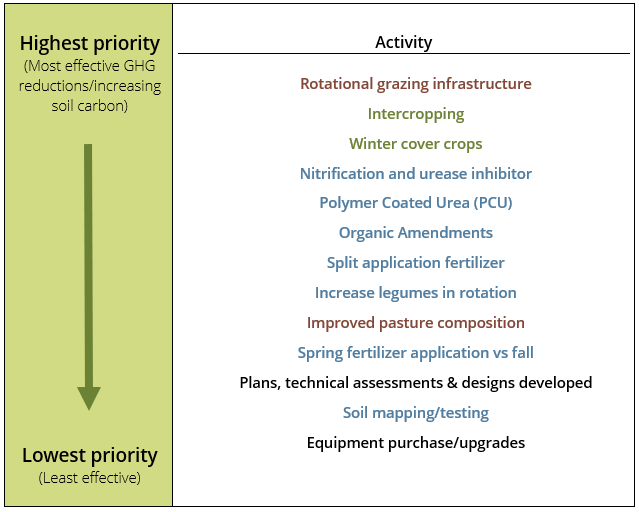
If the program funding requested exceeds funding available, applications will be prioritized based on their overall contributions to decreasing greenhouse gas emissions (GHG) or increasing soil carbon (see Appendix 1).

Applicants will be notified by email of funding decisions via the IAF Client Portal within 8 weeks of submitting a complete application. The status of an application can be seen at any time via the IAF Client Portal. All adjudication decisions are final.

Successful applicants will have up to four months to complete approved projects. All projects need to be completed by January 30, 2026.

Notifications & Obligations

Funding Notifications & Contracts

If an application is approved, IAF will inform the applicant of the details of the decision and any associated terms and conditions via email. This information is also available via the IAF Client Portal. An approval letter which outlines the obligations of each party to receive program funding will be added to the project documents section of the project in the IAF Client Portal, it’s important this document is reviewed in detail prior to starting project activities. If an application is not approved, the applicant will be informed via email. Funding decisions will be communicated as they are made, but no later than 8 weeks following the submission of a complete application. To see your project’s status, visit the IAF Client Portal.

Changes to Contracted Projects

Funding approval is specific to the activities and field/plot where they will occur. Participants cannot transfer approved funding between activities or farm locations.

If you are unable to complete a project activity as approved in your application or within the allotted timeframe, contact program staff immediately at caf@iafbc.ca for further guidance. Project changes could result in cancellation of funding.

Reporting Requirements

Successful applicants must complete a final report before receiving payment from the program. This report must be filled out and submitted to IAF along with all invoices for the project to be considered for funding reimbursement. The final report must be submitted on time and with all the required information.

Expenses will be reimbursed based on the submitted receipts, the approved project budget and the corresponding cost-share ratio. All reporting will be completed via the IAF Client Portal.

Payment of Funds

Payment for approved project costs will be made via a single electronic fund transfer (EFT) after all project expenses, activities, and project reporting is complete. No interim payments or advances will be considered.

Tax Considerations

Funding received through CAF is considered a “farm support payment” by the Canada Revenue Agency. Payments received through this program are considered income for the farm business and are subject to Income Tax. IAF will provide an AGR-1, Statement of Farm-Support Payments slip for all recipients who receive payments over $100.

Funding Acknowledgement

This program is funded by Agriculture and Agri-Food Canada, as such acknowledgement of funding is required when publicly communicating about a project and/or funding. To ensure appropriate acknowledgement, all communications and marketing materials, including public announcements or social media posts, must be pre-approved by the IAF Communications Team. Materials can be submitted via the IAF Client Portal.

Prioritization

Applications may be prioritized based on their overall contributions to decreasing greenhouse gas emissions (GHG) or increasing soil carbon.

  • Nitrogen management activities
  • Cover Cropping activities
  • Rotational grazing activities
  • Across categories activities
CAF Prioritization Criteria

Ready to Apply?

Applications Closed

Applications closed on September 11, 2025, at 4 PM PT.

Resources

FAQ

Your organization must register through the IAF Client Portal to apply to IAF programs. Please note, if you have not already registered this process can take up to 2 business days and must be completed before the application deadline.

Eligible expenses that have already been incurred can be included in your application and will be considered retroactively (applies only to costs incurred from April 1, 2025, onwards).

Note: Any costs incurred prior to a funding decision by IAF are entirely at risk of the applicant (should funding not be awarded), and application to the program does not guarantee funding.

Payment for approved project costs will be made via a single electronic fund transfer (EFT) after all project expenses, activities, and project reporting is complete. No interim payments or advances will be considered.

To get your EFT information set up to ensure timely delivery of your payment(s), please follow the directions provided here to update your client portal.

Project length can be up to 4 months from approval and must be completed no later than January 30, 2026.

Farmers are subject to a maximum funding amount of $100,000 over the program lifetime. This funding maximum includes funding received through CAF and BCCAF (2022-2025).

Yes, you can participate if you’re under the maximum funding cap of $100,00 and plan to complete one of the following:

  • Apply a new practice for the first time on a farm or specific field/parcel
  • Expand a previously used practice to a new field/parcel where it has not previously been applied
  • Continue a practice that was previously applied as part of the BCCAF program

Each practice activity must be reviewed and recommended/approved by an Agrologist before application or as part of the project approval process. If you have consulted with an Agrologist before submitting your application, you will be required to indicate that in the application form and provide their name and describe how you received advice (e.g. site visit, emails/photos, plan/design/assessment) and provide applicable supporting documents. If you haven’t consulted an Agrologist, your application will undergo technical review by an Agrologist after submission.

If you have consulted with an Agrologist before submitting your application, you will be required to indicate that in the application form and provide their name, describe how you received advice (e.g. site visit, emails/photos, plan/design/assessment) and provide applicable supporting documents.

Yes, the costs for planning, assessment, design work, consultancy fees and other agronomic support to support the adoption of eligible beneficial practices can be included in your application. Agrologist support can be included in the same application as other practices as long as all work can be completed within the 4-month project period.

No, this program does not permit PCUs and dual inhibitors (nitrification and urease) to be applied to the same acres. These practices will need to be applied to separate acres to be eligible for funding.

Have a Question?

Contact the IAF Team

Program Guide

Download the Program Guide.

Map Guidelines

Not sure how to create the map for your application? Download our guidelines.

Agrologist List

Download list of Agrologists who have indicated they provide consulting services and are registered with the BC Institute of Agrologists.

Have an Active Project?

Please visit the program’s Project Resource Hub for more information.

Funding Acknowledgement Requirements

Download the Funding Acknowledgement Requirements.

Funding provided by:

Agriculture and Agri-Food Canada

Please note: the Government of Canada may, from time to time, give instructions to IAF in relation to the delivery and administration of this program. IAF must and will comply with those instructions.